#1 Overall Winner
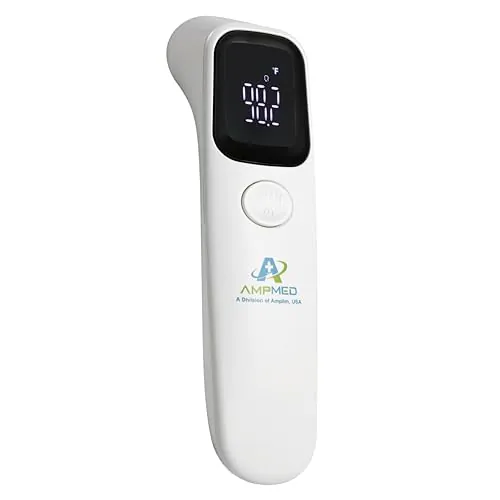
Amplim No-Touch Infrared Forehead Thermometer
- Non-contact infrared forehead readings
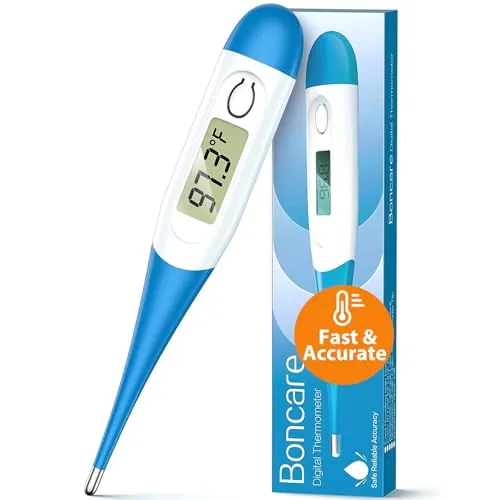
Comparison
Amplim is stronger for fast, touch-free family temperature checks, with quiet operation, a bright display, and higher usability scores. Boncare is a lower-cost, compact probe thermometer with oral, rectal, and axillary options. The core trade-off is Amplim's convenience and broader practical strengths versus Boncare's lower price and measurement-location flexibility.
#1 Overall Winner
Contender
Amplim is better overall because it pairs a touch-free format with faster readings and stronger scores in most practical categories. Boncare is better for buyers who need oral, rectal, or axillary use at the lowest listed cost. Both have mixed review feedback on reading consistency, so follow their operating instructions carefully.
Overall winner
Depends on your needs
| Feature | Amplim No-Touch Infrared Forehead Thermometer | Boncare 10 Seconds Oral Thermometer | Winner |
|---|---|---|---|
| Overall score | 74 | 60 | Amplim No-Touch Infrared Forehead Thermometer |
| Measurement format | Non-contact infrared forehead | Oral, rectal, or axillary probe | Depends |
| Response time | 1 second | About 10 seconds | Amplim No-Touch Infrared Forehead Thermometer |
| Health awareness | Strong household temperature-checking support | Strong household temperature-checking support | Tie |
| Nighttime use | Quiet operation; LED display | No nighttime-specific feature stated | Amplim No-Touch Infrared Forehead Thermometer |
| Comfort | 88 score; no-contact format | 78 score; soft silicone probe tip | Amplim No-Touch Infrared Forehead Thermometer |
| Ease of use | 92 score | 88 score | Amplim No-Touch Infrared Forehead Thermometer |
| Tracking accuracy | 66 score; mixed consistency feedback | 58 score; mixed consistency feedback | Amplim No-Touch Infrared Forehead Thermometer |
| Data and memory | Memory recall; 55 data-insight score | Last-reading memory; 20 data-insight score | Amplim No-Touch Infrared Forehead Thermometer |
| Build quality | 72 score | 52 score | Amplim No-Touch Infrared Forehead Thermometer |
| Durability | 68 score | 38 score | Amplim No-Touch Infrared Forehead Thermometer |
| Maintenance | 86 score; wipe clean | 72 score; waterproof probe requires cleaning | Amplim No-Touch Infrared Forehead Thermometer |
| Portability | 89 score | 92 score; lightweight case included | Boncare 10 Seconds Oral Thermometer |
| Value | 84 score; $26.58 | 84 score; $6.71 | Tie |
| Warranty and support | 62 score; one-year warranty card included | 28 score; warranty terms not provided | Amplim No-Touch Infrared Forehead Thermometer |
Both products have the same health-impact score and serve a similar basic role: helping households check body temperature. Amplim supports fast forehead checks without contact, while Boncare offers several contact measurement locations. Neither product's supplied data supports using it to diagnose a condition, and the mixed consistency feedback for both makes careful use and interpretation important. Their practical role is temperature awareness rather than broader health monitoring.
Amplim is more relevant to nighttime household use, reflected in its sleep-support score and its stated quiet operation. A one-second, no-contact forehead check may be more convenient when checking a sleeping child without unnecessary disturbance. Boncare has no supplied sleep-specific features or sleep-support score. Neither thermometer tracks sleep or is designed to improve sleep; this comparison concerns the convenience of temperature checks during nighttime routines.
Neither product is a recovery device, but Amplim has a higher recovery-support score because its quick, touch-free format may be more convenient for occasional temperature checks when someone is resting. Boncare's role is similarly limited to basic temperature measurement, with no recovery-specific features stated. Neither product measures training readiness, muscle status, or recovery quality, and neither should be viewed as a substitute for professional assessment when needed.
Amplim has a modest advantage for general household wellness routines, supported by its higher wellness score, easy-read LED screen, memory recall, and non-contact operation. Boncare remains useful as a simple temperature-checking tool, particularly as a portable backup. Neither offers broader wellness coaching, app-based trends, or behavior programs. Their value in a wellness routine is limited to convenient temperature awareness and maintaining a prepared home or travel kit.
Amplim has the higher effectiveness score. Its purpose-built non-contact forehead approach, one-second listed response time, large display, and quiet operation support efficient household checks. Many reviews describe it as easy and quick, though other reviews report variable readings, so the performance advantage should not be overstated.
Boncare is also designed for a straightforward core task and receives positive comments for quick, simple operation. Its lower effectiveness score aligns with more prominent feedback about inconsistent readings and failures. For the intended purpose of convenient day-to-day temperature checks, Amplim has the stronger available profile.
Neither product is a recovery device, but Amplim has a higher recovery-support score because its quick, touch-free format may be more convenient for occasional temperature checks when someone is resting. Boncare's role is similarly limited to basic temperature measurement, with no recovery-specific features stated. Neither product measures training readiness, muscle status, or recovery quality, and neither should be viewed as a substitute for professional assessment when needed.
Amplim has a higher evidence-quality score, but the supplied product information is mainly feature descriptions, scoring data, and customer feedback rather than independent validation. Its non-contact format and stated operating instructions are product-function information, not proof of accuracy under every condition.
Boncare's listing states that its temperature-reading function has been clinically tested, but no study design, results, or independent source is provided. That claim therefore cannot be assessed further from the available data. Reviews for either item reflect user experience and should not be treated as clinical evidence. Both products have limited evidence detail in the supplied material.
Amplim has the higher safety score and avoids probe contact through its infrared forehead design, which may reduce cross-contact during routine household use. It is also explicitly designed for human body-temperature measurement. Proper positioning remains relevant because the supplied reviews and listing emphasize correct use.
Boncare has a soft silicone tip, a stainless-steel probe, and a waterproof tip intended for cleaning. Its listing advises reading the manual and avoiding contact between the probe and hands or hot objects before measurement. Neither product's supplied information supports treating a reading as a diagnosis; use the product instructions and seek appropriate guidance when concerned.
Amplim leads on comfort, with a higher score and a no-contact forehead format. This can be especially practical for infants, toddlers, or anyone who dislikes holding a probe in place. Its quiet operation also supports less disruptive use.
Boncare's soft silicone tip is a considered feature for a contact thermometer, and its compact form is straightforward to handle. Still, oral, rectal, and axillary use requires physical contact and positioning. For the least intrusive routine experience, Amplim has the clear advantage.
Both thermometers score well for ease of use, but Amplim leads. It combines a simple press operation with one-second readings, a bright LED display, unit switching, and memory recall. Reviews frequently praise its legibility and speed, although one review found the manual vague.
Boncare is also simple, with a readable LCD screen, beeper, memory, and auto-off. Its probe requires selecting and using an appropriate measurement location, plus cleaning after use. The difference is modest, but Amplim has fewer handling steps for routine checks.
Amplim has the higher build-quality score. Available reviews generally describe an easy-to-hold device with a clear display, although the data also includes an isolated concern about product batch freshness. Its supplied construction detail is a plastic outer body.
Boncare is extremely lightweight and includes a protective case, but its lower build-quality score reflects repeated aggregated feedback calling out quality problems and early breakage. Individual buyers still report good quality, so outcomes are not uniform. On the available information, Amplim appears to be the more dependable physical product.
Amplim has a substantially higher durability score. Its reviews include strong satisfaction with repeated use, although the supplied feedback is not enough to establish long-term reliability for every unit. A one-year warranty card is included, which provides clearer ownership support than the Boncare data.
Boncare's durability score is held back by repeated reports of units failing after limited use and concerns about battery life. It uses a replaceable LR41 battery, but replacement does not resolve every reported reliability issue. Amplim is the safer pick when expected longevity matters.
Amplim leads for maintenance. It is listed as wipe-clean and uses included AAA batteries, with a higher maintenance score. Boncare's waterproof probe can be cleaned with water or disinfected with medical alcohol, but this contact-use process requires more regular attention. Boncare's replaceable battery is practical, though reviews cite battery-life concerns.
Boncare has a narrow portability advantage. It weighs 10.5 grams, has compact listed dimensions, and includes a protective storage case. Amplim is also highly portable and battery-powered, but it is larger by listed length and no case is specified. Both can suit a home kit or travel bag.
Amplim has the higher tracking-accuracy score, but neither product has consistently positive accuracy feedback. Amplim owners often praise reliable, repeatable results when following its forehead distance and placement instructions, while other customers report readings that vary under similar conditions.
Boncare also receives positive reports for accuracy, but reviews include immediate rechecks with noticeable variation. Its lower score reflects this mixed reliability pattern. Neither supplied dataset establishes medical-grade accuracy. For either product, follow the manual, use a consistent technique, and recognize that a single consumer-device reading has limits.
Neither thermometer provides connected dashboards, long-term reports, or app-based recommendations. Amplim has the stronger data-insight score because it stores previous readings, which can help a user compare recent checks. Boncare offers memory for the last reading, giving it a more limited form of recall.
These functions support basic reference rather than comprehensive trend analysis. Users seeking detailed health tracking will not find advanced insights in either product; the practical choice is between Amplim's stronger memory utility and Boncare's simple last-reading function.
Personalization is limited for both products. Amplim scores higher because it provides Fahrenheit/Celsius switching, memory recall, and a fever alert within a non-contact format. Boncare also supports Fahrenheit/Celsius switching and includes an alarm, but its main flexibility comes from oral, rectal, and axillary use rather than configurable settings.
Neither item has user profiles, custom thresholds, app settings, or personalized recommendations in the supplied data. Choose based on preferred measurement method rather than expecting extensive customization.
The two products receive equal value scores, but they deliver value in different ways. Boncare's very low listed price, compact case, and multiple probe-use options make it a practical low-cost backup or travel purchase. Its value case is weakened by lower build-quality and durability scores, plus customer reports of battery and reliability issues.
Amplim costs more, but its non-contact format, one-second readings, quiet operation, prominent display, stronger durability-related scores, and included one-year warranty card provide additional practical value. The better purchase depends on whether low upfront cost or a more convenient touch-free experience is more important.
Amplim has the higher brand-trust score, supported in the supplied data by stronger overall product performance, higher customer satisfaction, and a stated one-year warranty card. This is a relative comparison rather than a definitive assessment of either brand's broader reputation.
Boncare has a lower brand-trust score, reflecting more substantial quality, durability, and warranty-support concerns in the available assessment. The provided data does not offer detailed information on either brand's support operations, transparency, or return handling. Product-level review patterns are the main available trust signal here.
Amplim has the higher customer-satisfaction score and a 4.5 out of 5-star average from 22,673 reviews. Repeated praise centers on fast operation, readability, touch-free convenience, and value. Its main negative theme is inconsistent readings, with some users stressing the importance of correct positioning.
Boncare has a 4.3 out of 5-star average from 24,760 reviews and is often praised for its price, simple controls, quick readings, and storage case. However, reviews more frequently raise concerns about inconsistent results, failures, quality, and battery life. Amplim has the stronger buyer-feedback profile overall.
Amplim has the higher warranty-support score and explicitly includes a one-year warranty card in the box. This gives buyers a clear item-level support signal, although full warranty terms are not supplied. Boncare's supplied details list a thermometer, manual, and case but do not state warranty terms. Its lower score and reported reliability issues make Amplim the stronger choice for support confidence.
Amplim No-Touch Infrared Forehead Thermometer is the clearer overall winner. It outperforms Boncare across most supplied practical-use scores and offers a faster, quieter, non-contact experience that better suits frequent family checks. Boncare 10 Seconds Oral Thermometer remains a credible budget and travel-oriented alternative for buyers who value probe-based oral, rectal, or axillary use. The key caution for both is mixed customer feedback about reading consistency.
Overall winner
Depends on your needs
The Amplim is the stronger overall option in the available scoring, particularly for ease of use, comfort, durability, and customer satisfaction. Its touch-free, one-second format is practical for household checks. Boncare remains a sensible lower-cost alternative for buyers who specifically want oral, rectal, or axillary measurement options.
Amplim is the better fit for this use because it is a non-contact forehead thermometer with quiet operation and a one-second response time. Boncare requires probe contact and takes about 10 seconds according to its listing, which can be less convenient when minimal disturbance is the priority.
Boncare offers greater measurement-location flexibility because its probe is listed for oral, rectal, and axillary use. Amplim is designed specifically for human body-temperature checks using a non-contact forehead method. The better choice depends on whether touch-free convenience or multiple probe-placement options matters more to your household.
Amplim has the higher tracking-accuracy score, but neither product has uniformly positive accuracy feedback. Some owners of each thermometer report reliable readings, while others describe variation between checks. Correct use matters: Amplim reviews emphasize following the stated forehead distance and placement guidance, while Boncare advises avoiding contact with hot objects before use.
Both products receive the same value score. Boncare costs less and includes a case, making it attractive for a basic backup or travel thermometer. Amplim costs more but adds touch-free operation, a faster listed response time, a large LED display, and stronger scores across several practical-use categories.
Both are designed for simple use, but Amplim has the higher ease-of-use score. Its non-contact format, large LED display, and one-second reading reduce handling steps. Boncare also uses straightforward controls, though probe placement, cleaning, and its different measurement locations add a little more day-to-day process.
Amplim scores higher for maintenance and is listed as wipe-clean. Boncare has a waterproof tip that can be wiped with water or disinfected with medical alcohol, but its probe needs cleaning around each use. Both use replaceable batteries, although Boncare reviews include some battery-life complaints.
No. The provided information does not establish medical-grade accuracy for either thermometer. Boncare's listing says its temperature-reading function has been clinically tested, but no supporting study details are supplied. Customer reviews can describe individual experiences, but they do not independently verify measurement performance or clinical claims.
Check our rankings and expert guides to find the best health products for your goals.